
The Hidden Physics of Armour Stone: Why the Upfront Cost Saves Your Shoreline in 10 Years
Most people looking at armour stone retaining walls for the first time have the same reaction: that’s a lot of money for some rocks.
It’s a fair thought. Armour stone sits at the higher end of retaining wall costs, and on a quote sheet it can look hard to justify compared to concrete block or timber alternatives. But that comparison only holds up if you’re looking at the first year. Stretch the view out to five, ten, or fifteen years, especially on a sloped property, a waterfront lot, or anything dealing with Ontario’s freeze-thaw cycles, and the numbers start telling a different story.
This guide breaks down what armour stone actually is, how it works, what it costs, and why the upfront investment tends to look smarter the longer you own the property.
What Is An Armour Stone?
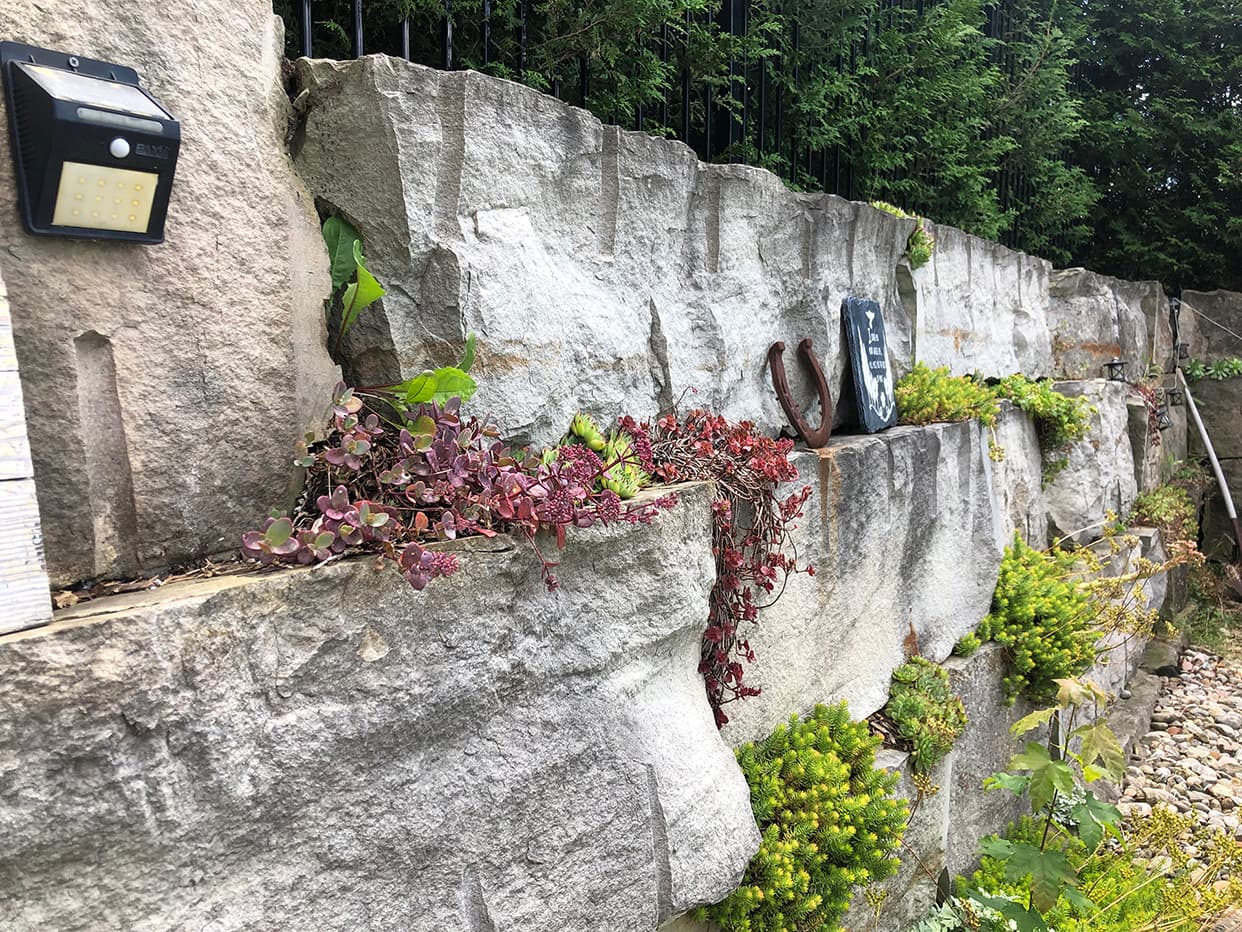
Armour stone is exactly what it sounds like: large, heavy, natural rock used as a structural and protective material. It’s typically quarried limestone or granite, cut into blocks that weigh anywhere from a few hundred pounds to several tonnes per piece.
Most armour stones range from 0.5 to 2 tons per piece. That size and weight isn’t incidental, it’s what makes armour stone effective at holding soil, resisting wave action, and staying in place through the kind of freeze-thaw cycles and frost pressure that Ontario winters deliver year after year.
In residential landscaping, it’s used for retaining walls, garden edging, steps, water features, and shoreline protection. In commercial and municipal settings, it’s a standard material for erosion control and waterfront infrastructure.
Armour Stone Vs Concrete Retaining Walls
Concrete and armour stone are both serious retaining wall materials, but they’re built on different principles and suited to different conditions.
Concrete relies on engineered reinforcement and monolithic structure to resist lateral pressure. It’s strong, predictable, and versatile in terms of form. The trade-off is that water management has to be designed explicitly, weep holes, drainage pipe, gravel backfill. Armour stone does not crack, shift, or deteriorate and supports large soil and water loads. Its stacked, dry-laid construction drains naturally, which is a significant advantage on wet sites, waterfront properties, and anywhere frost heave is a recurring concern.Armour stone costs $40–$100 per square foot installed, making it a premium choice for robust, long-lasting retaining walls. Concrete sits lower on cost for most standard installations. But on sites where drainage complexity, shoreline exposure, or long-term aesthetics matter, armour stone often delivers better value over the life of the wall.
Best Uses For Shoreline Armour Stone Walls
Shoreline applications are where armour stone genuinely earns its price premium over other materials.
Waterfront properties in Ontario deal with a specific combination of stresses: wave action, ice pressure, water level fluctuation, frost heave, and the constant moisture exposure that degrades timber and concrete over time. Shoreline properties are prone to erosion, wave impact, water deterioration, soil loss, and ice pressure. Armour stone and revetment rip rap acts as a natural barrier that absorbs energy and prevents these conditions from damaging land or built structures.
Unlike concrete seawalls, which reflect wave energy, often accelerating erosion in front of the wall, armour stone absorbs and dissipates it. That means less secondary damage to the surrounding shore. For cottage properties on Ontario lakes, properties along rivers, and any waterfront where ice movement is a seasonal reality, armour stone is consistently the most durable and lowest-maintenance option available.
How Heavy Are Armour Stones?
Armour stone is genuinely heavy, not in the way landscaping blocks are heavy, but in the way that moving them requires machinery.
Most armour stones range from 0.5 to 2 tons per piece. The pieces used for garden borders and lower decorative walls are at the smaller end. Full structural wall and shoreline protection blocks are typically in the 1–3 tonne range.
That weight is the core of how armour stone works. It doesn’t rely on reinforcement rods, mechanical connectors, or adhesive to stay in place. The mass of each stone, combined with correct stacking and a solid compacted base, creates a structure that resists pressure simply by being too heavy to move. Building an armour stone retaining wall isn’t a weekend DIY. It takes equipment, planning, and knowledge of proper drainage and structural support.
Drainage Requirements Behind Armour Stone Walls
One of armour stone’s practical advantages is that water can escape through the gaps between stones rather than building up as pressure behind a sealed face. But the drainage system behind the wall is still a critical part of the build, not an optional extra.
One of the most common causes of retaining wall failure is inadequate drainage, which leads to hydrostatic pressure buildup behind the wall. A compacted gravel backfill layer, a perforated drainage pipe at the base, and geotextile fabric to prevent soil migration into the drainage layer are the standard components of a correctly built system.
Proper drainage, gravel, pipes, and fabric, adds $15–$60 per linear foot but saves thousands in potential collapse repairs. On any waterfront or high-rainfall site, that cost is not optional.
Common Mistakes In Boulder Retaining Wall Installation
Most armour stone wall problems trace back to a short list of installation errors, and most of them happen before the first stone goes in.
Inadequate base preparation is the most common. A compacted gravel base is essential for distributing the weight of the stones and preventing settling over time. A compacted gravel base is crucial to help support the heavy stones and prevent settling over time. Skip it or underbuild it and the wall shifts, often within the first couple of winters.
Poor stone selection for the application is another recurring issue. Smaller stones placed where larger ones were needed, or mixed sizes stacked without structural logic. For armour stone, the largest rocks should be strategically positioned in the footing trench to create a low centre of gravity, using physics to ensure stability.
Drainage is the third. Even with armour stone’s natural permeability, the backfill system matters. Walls installed without proper gravel backfill and drainage pipe develop water pressure problems regardless of how well the stones are placed.
How Long Do Natural Stone Retaining Walls Last?
Natural stone walls last as long as anything in residential construction, and sometimes longer.
When installed professionally and maintained properly, armour stone retaining walls can last for 50 years or more. Some historic stone walls across Ontario and elsewhere have been standing for well over a century, which reflects what the material is capable of when the fundamentals are right.
In practical terms for a residential installation in Ontario, a properly built armour stone wall should be a one-time build. The maintenance it requires, periodic inspection, clearing of drainage outlets, occasional weed removal between stones, is minimal compared to the intervention that timber or deteriorating concrete block eventually demands. Timber walls have a shorter lifespan, typically between 10–20 years, due to potential decay. That lifespan difference is a core part of the total cost comparison.
Residential Vs Commercial Armour Stone Landscaping
The distinction between residential and commercial armour stone work is mainly one of scale and regulatory complexity, not material performance.
For residential projects, armour stone is commonly used for backyard retaining walls, shoreline work on cottage and waterfront properties, feature walls, steps, and garden terracing. The projects are typically in the $5,000–$60,000 range depending on scope and site conditions. On average, prices for armour stone retaining walls can range from $40 to $100 per square foot, including materials and labour.
Commercial installations involve larger volumes of stone, heavier equipment, more complex site logistics, and in most cases formal engineering and permit requirements. Municipal shoreline protection, highway slope stabilisation, and commercial landscape features are all common commercial applications. The material behaves the same way, it’s the project management, documentation, and scale that differ.
Cost Factors For Armour Stone Retaining Walls
Armour stone is a premium material and the cost reflects that, but the variables that drive the final number are worth understanding before you get quotes.
The cost of an armour stone retaining wall varies depending on factors such as the size of the wall, the type of stone, the design complexity, and site preparation. On average, prices can range from $40 to $100 per square foot, including materials and labour.
Stone size is one of the bigger variables. Heavier stones cost more per tonne and require larger equipment to handle. Ontario suppliers list armour stone at $45–$239 per tonne. Heavier stones increase transport fees because most roll-off trucks max out at 14–16 tonnes per load.
Site access is another significant factor. If your backyard gate is narrower than 8 feet, crews must crane stones over the house or hand-dolly smaller pieces, both premium-priced scenarios. Excavation and compacted gravel base preparation add $8–$15 per square foot on top of the stone and placement costs. For walls over one metre in Ontario, engineering stamps and municipal permits typically add $1,500–$3,500 to the project total.
Can Armour Stone Be Used For Waterfront Protection?
Waterfront protection is one of armour stone’s strongest applications, and for Ontario cottage and lakefront properties, it’s consistently the recommended solution for serious shoreline work.
Benefits of armour stone shoreline protection include reduced erosion, long-term protection of foundations, docks, and waterfront structures, improved property appearance, and long-term property value retention.
The physics work in its favour at the water’s edge. The mass of the stone resists ice push and wave impact. The natural gaps between stones dissipate wave energy rather than reflecting it back toward the shore. And unlike timber, which deteriorates rapidly in the persistent wet-dry cycling of a shoreline environment, armour stone is unaffected by moisture. Waterfront retaining walls are not DIY projects. They require specialised knowledge of marine engineering and drainage. A failed wall can cause catastrophic damage.
Do Armour Stone Walls Need Footings?
Armour stone walls don’t need a poured concrete footing in the conventional sense, the weight of the stones provides the resistance that a footing would otherwise supply. But they do need a prepared base that functions like a footing in terms of stability and load distribution.
In practice, that means excavating firm, undisturbed ground, installing a compacted crushed gravel layer, and setting the first course of stones partially below grade. The depth below grade depends on wall height and local frost depth, for Ontario’s climate, getting the base below seasonal frost movement is important to prevent heaving over winter.
For armour stone, the largest rocks are strategically positioned in the footing trench to create a low centre of gravity. The mass and positioning of that first course is the foundation of everything above it, and it’s where most of the critical installation decisions are made.
Performance Over Time Matters
Armour stone isn’t the cheapest retaining wall option, and it’s not meant to be. It’s a material built for applications where performance over time matters more than minimising the initial quote.
On sloped Ontario properties, waterfront lots, and anywhere freeze-thaw cycles and soil pressure put real demand on a retaining structure, armour stone consistently delivers what lighter or less durable materials don’t: a wall that handles the conditions it faces without constant intervention. The upfront cost is real. So is the lifespan, the low maintenance demand, and the value it holds in the landscape over decades.
If you’re building something you genuinely don’t want to rebuild in ten years, armour stone is worth the serious look.
Have Questions About Your Project?
Our team of experts is here to help you make the right decisions for your property.